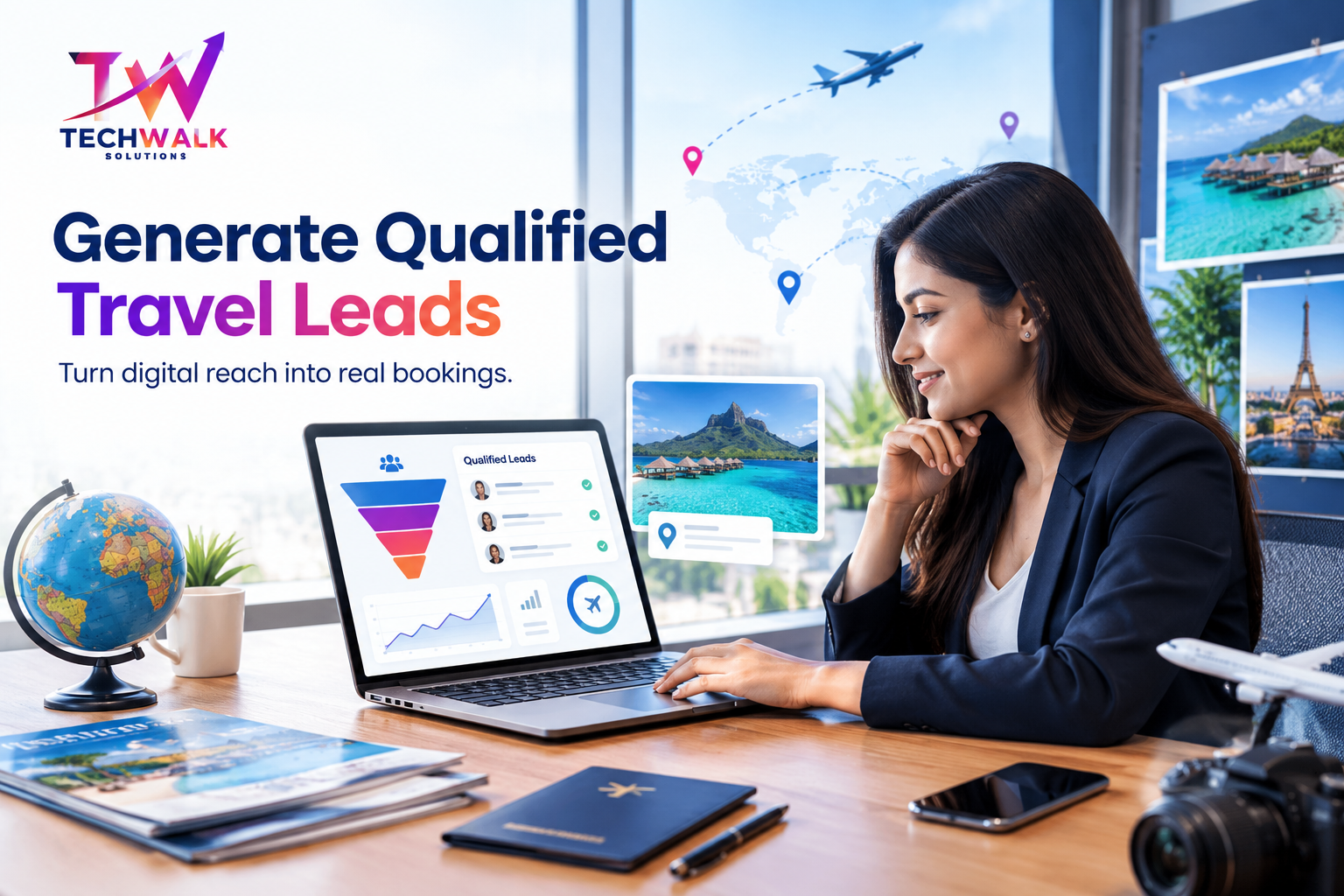
Picture a travel agency that receives 50 enquiries in a week and books two. The rest asked for a price and went quiet, were comparing five sellers, or had dates and budgets that matched nothing on offer. A full inbox looks like progress, but it is not revenue.
That gap is the real subject of how travel agencies can generate qualified leads through digital marketing. In short: attract people whose destination, budget, dates and group size fit what you sell, make enquiring easy, reply well, and measure bookings instead of clicks. The same principles apply to digital marketing for tour operators, DMCs and pilgrimage tour providers.
What Is a Qualified Lead for a Travel Agency?
A qualified lead is an enquiry from someone with a realistic chance of booking with you. They want a trip you actually sell, their budget fits your pricing, their travel window is workable, and they show intent by asking about inclusions, availability or payment terms rather than only “the rate.”
Compare two illustrative enquiries. The first reads, “Send Kedarnath package details.” The second reads, “Family of four, six nights, leaving Delhi in mid-May, vegetarian meals, want to confirm this week.” The second is quicker to quote and much more likely to close. That is why enquiry quality matters more than enquiry volume.
7 Digital Marketing Strategies to Generate Qualified Travel Leads
1. Use SEO to Attract Travellers With Booking Intent
SEO for travel agencies pays off when each page matches a specific search. Someone typing “things to do in Rajasthan” is still exploring. Someone searching “Jaipur Udaipur 5 night package from Chandigarh” has chosen a route and is comparing sellers. The second search is narrower and much closer to a booking, so it deserves its own page.
Base keyword research on destination, trip type, length, departure city and budget level. Give each profitable package a dedicated page instead of one catch-all “Tour Packages” page, and link guides such as best time to visit or sample itineraries to the matching package. If you run an office, keep your Google Business Profile consistent with your website. Google states that its ranking systems favour content written to help people rather than to manipulate rankings, so write for the traveller first.
2. Use Google Ads to Reach High-Intent Travellers
Paid search suits packages you want to sell now. Google Ads for travel agencies works best when ad groups follow intent, such as one for “Char Dham yatra package” and another for “Dubai family tour,” each sending clicks to a matching landing page rather than the homepage. Target only the locations you can serve.
Add negative keywords for searches you do not want, such as “free” or “jobs.” Google notes that negative keywords exclude search terms and help you focus on the ones that matter, although too many can limit reach.
Chasing the cheapest lead usually attracts the least committed enquirers. Suppose one campaign brings 40 cheap leads and no bookings, while another brings eight well-matched ones and three bookings. The first looks better in the dashboard and performs worse in the business. Track form submissions, calls and WhatsApp clicks, then judge campaigns by what your sales team reports back.
3. Use Social Media Marketing to Build Interest and Generate Enquiries
Facebook and Instagram make destinations desirable, but desire is not intent, so treat awareness and enquiry as separate jobs. Short destination videos and itinerary snapshots build familiarity. Enquiry campaigns promote a single package with dates, price and one clear action, through a lead form or a WhatsApp message. Social media marketing for travel agencies is easier to measure when the two are not mixed in one post. TechWalk’s guide to social media marketing for lead generation covers the wider picture.
Add one qualifying question to lead forms, such as travel month or group size. Use traveller photos and reviews only with permission, never publish invented testimonials, and check the consent and privacy rules in your market before retargeting package-page visitors.
4. Create Useful Travel Content That Answers Customer Questions
Content marketing for travel companies reaches people earlier in their planning. Destination guides, sample itineraries, seasonal advice, budget breakdowns and package comparisons answer questions travellers already have. An honest guide builds trust, and a closing section can point to the matching package.
Accuracy matters here. Prices, visa requirements, permit rules and cancellation terms change, and one wrong detail can cost a customer money. Date time-sensitive guides, review them on a schedule, and send readers to official sources for visa and entry rules.
5. Optimize Landing Pages to Convert Visitors Into Enquiries
A travel package landing page converts only if it answers practical questions. A weak page for a Himachal package might show three photos, a “starting from” price and a “Contact us” link. A stronger one adds a day-wise itinerary, inclusions and exclusions, the price basis, departure dates, hotel categories, cancellation terms, real traveller reviews, and a visible call or WhatsApp button beside a short form.
Keep the form to a few fields, such as name, phone, travel month and number of travellers. Say what happens next, and promise only what your team can deliver.
6. Use Lead Nurturing and Follow-Ups to Reduce Lost Enquiries
Many bookings are lost after the enquiry arrives, because the customer has often asked several agencies. Record destination, dates, group size, budget range and lead source for every enquiry, and sort leads by stage: new, quoted, negotiating, booked, lost. A CRM suits this well, and TechWalk has compared CRM software for travel agencies.
Reply with a recommendation, not a brochure. Follow up once after the quote and once before it expires, only through channels the customer has agreed to. Do not invent scarcity such as “only two seats left,” and do not message repeatedly. Lead nurturing should feel like service, not pressure.
7. Track Lead Quality, Not Just Traffic
Traffic reports show interest, not revenue. Track the full chain: organic clicks and impressions, cost per lead for paid campaigns, the share of leads your team marks as qualified, the enquiry-to-booking rate, cost per qualified lead, and booking value where attribution is reliable.
Google Ads can import offline results such as “lead qualified” or “deal won,” so that bidding can learn from what happens after the enquiry. The cheapest lead is rarely the most profitable: a channel with a low cost per lead that never books is more expensive than one with a higher cost that books regularly.
How to Build a Practical Lead Generation Plan
Foundation
List your most profitable packages and the customers who book them. Map the searches those customers use, and find where enquiries drop off today, whether at the page, the form or the first reply.
Acquisition
Improve SEO and landing pages for your best packages first. Then test Google Ads or social campaigns for one or two of them, within a budget you fix in advance.
Optimization
Review qualified enquiries every month, follow up consistently, and move budget toward channels that produce bookings. Timelines and lead volumes vary by market and season, so set targets from your own data.
How TechWalk Solutions Can Help Travel Businesses
SEO, advertising, social media, the website and tracking all affect one another, which is where many small agencies struggle. Digital marketing services from TechWalk Solutions include SEO, PPC, social media management, email marketing and content writing, and the agency also offers website design and development for landing pages and enquiry forms. A first step can be a market analysis and audit of your current site, ads and enquiry handling.
TechWalk Solutions is a digital marketing agency based in Sahibzada Ajit Singh Nagar (Mohali), Punjab.
Travel agency lead generation is less about attracting more people and more about attracting the right ones. Match pages and ads to specific searches, make enquiring easy, reply with something useful, and count bookings rather than clicks. That is how a travel business can increase direct bookings without depending on volume alone.
If your current mix of SEO, ads and social media brings plenty of enquiries and few bookings, find where qualified leads are being lost before raising the budget. You can also explore TechWalk Solutions services or ask for a review of your existing digital marketing.