Your website is online and the contact form technically works. Yet enquiries have slowed, visitors leave within seconds, and you hesitate before sending clients to the link. Websites rarely fail all at once. They age quietly, and the cost shows up as missed opportunities. A website redesign service makes sense when problems accumulate, but not every issue needs a rebuild. This checklist covers 12 signs your site needs an upgrade, how to check each one yourself, and how to tell a quick fix from a genuine redesign.
A business website needs a redesign when it looks dated, struggles on mobile, loads slowly, confuses visitors, produces few enquiries, or cannot be easily updated, secured, or expanded. One issue can often be fixed alone. Several together usually point to a redesign.
Why Website Redesign Matters for Modern Businesses
Visitors judge a business within moments of landing on its website. Their standards come from the best sites they use daily, and devices, browsers, and search engines keep changing. A site built several years ago may no longer suit any of them.
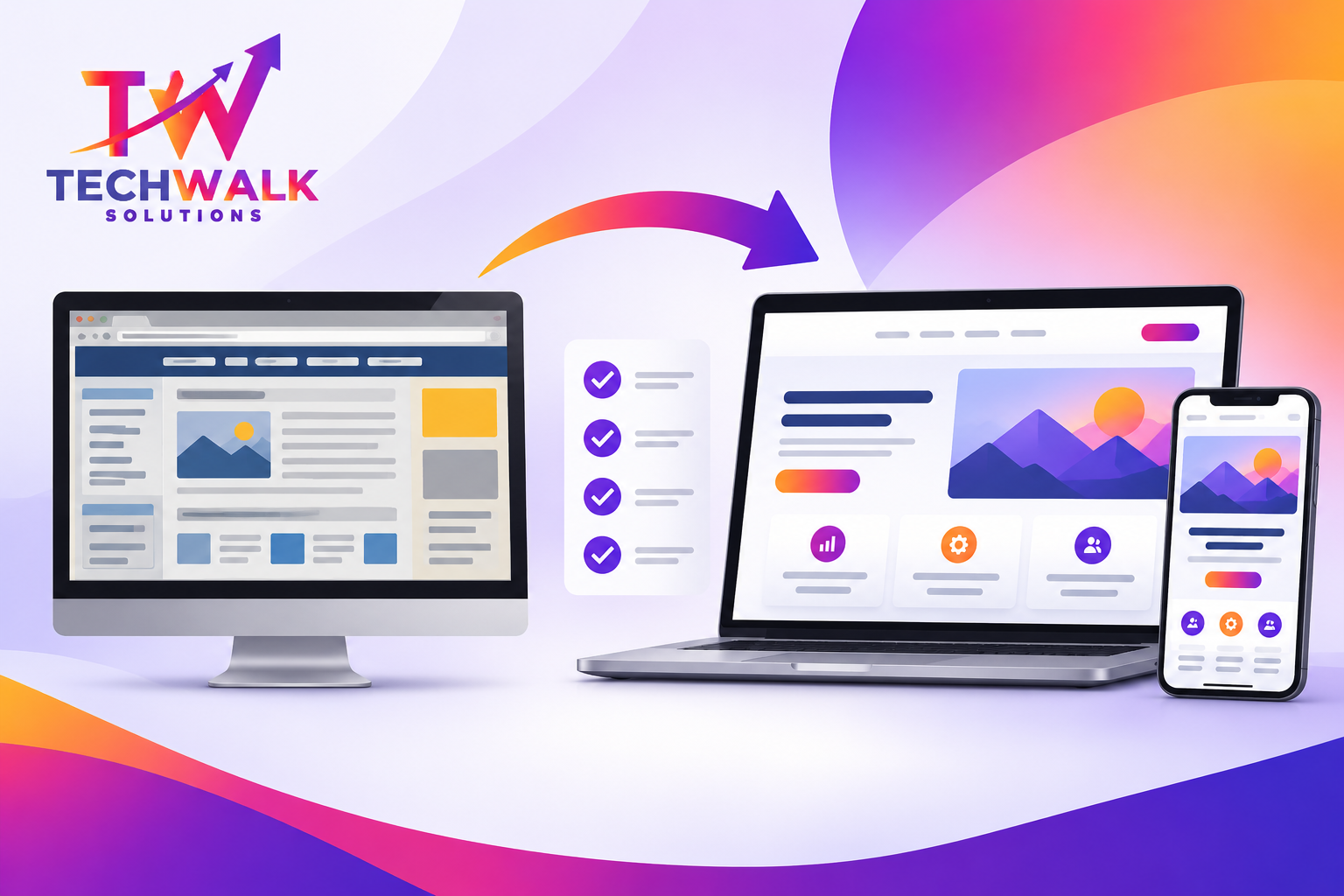
A website redesign is a planned rework of a site’s structure, design, content, and technology to fix specific problems. It differs from maintenance and from a visual refresh:
| Type | What it involves | Usually right when |
|---|---|---|
| Maintenance | Software and plugin updates, security patches, backups, broken link fixes | The site works but needs regular care |
| Refresh | Updated visuals, copy, or a few key pages on the current platform | The structure is sound but looks or reads dated |
| Redesign | Reworked structure, UX, design, content, and often the platform | Several design, performance, or structure problems exist together |
A redesign should solve identified problems. New colors on top of confusing navigation just give you a nicer-looking site that performs the same way.
12 Signs Your Business Website Needs a Redesign
1. Your Website Has an Outdated Design
Cramped layouts, tiny text, mismatched fonts, and generic stock photos suggest a business that stopped paying attention. Outdated website design affects trust before anyone reads a word, especially when a competitor’s site looks sharper.
Quick check: Open your homepage beside three competitors’ sites on your phone and note which one you would trust first.
2. Your Website Does Not Work Properly on Mobile Devices
Many visitors arrive on phones. Warning signs include text that needs zooming, hard-to-open menus, buttons too small to tap, and tables that run off the screen. A responsive website redesign adapts layouts to each screen size instead of squeezing the desktop version onto a phone.
Quick check: Browse your key pages on a real phone, then run a Lighthouse audit in Chrome DevTools.
3. Your Website Loads Slowly
Oversized images, excess scripts and plugins, inefficient code, and limited hosting usually cause slow pages. Google’s Core Web Vitals thresholds call for Largest Contentful Paint within 2.5 seconds, Interaction to Next Paint within 200 milliseconds, and Cumulative Layout Shift of 0.1 or less, measured at the 75th percentile of visits. A redesign does not automatically fix speed. A heavy new design on weak hosting stays slow.
Quick check: Test your homepage and top service page in PageSpeed Insights. Read the real-user field data first, then the diagnostics.
4. Visitors Struggle to Find Important Information
Picture a clinic website where appointment details sit three clicks deep under a menu called “Solutions.” Vague labels and missing service information force visitors to hunt. Good website navigation uses plain wording, so services, location, and contact details are a click or two away.
Quick check: Ask someone unfamiliar with your business to find your services and contact details. If they hesitate, your visitors do too.
5. Your Website Generates Very Few Enquiries or Conversions
Unclear calls to action, long forms, thin service pages, and missing trust signals such as genuine reviews weaken the website conversion rate. A redesign can improve conversion opportunities, but it cannot guarantee more leads. Your offer and traffic quality matter too.
Quick check: Compare how many people view your enquiry form with how many submit it, and see which pages they leave from.
6. Your Website Is Not Optimized for Search Engines
Duplicate or missing title tags, weak internal linking, disorganized content, and crawl problems can keep good pages from being found. Technical SEO should be planned before and during a redesign, not patched afterwards, because structural decisions affect how search engines crawl the site.
Quick check: Open the Pages report in Google Search Console to see which URLs are indexed and why others are not.
7. Your Website Content Is Outdated or Inaccurate
Old service descriptions, discontinued products, decade-old photos, and wrong phone numbers cost you directly, since a wrong contact detail loses an enquiry outright. Website content optimization is often the cheapest improvement, and sometimes it is all you need.
Quick check: List every page and check phone numbers, addresses, services, prices, and dates against what is true today.
8. Your Website Does Not Reflect Your Current Brand
If you have launched new services, changed positioning, or updated your logo, the website should reflect it. An old tagline or messaging aimed at customers you no longer serve creates a gap between the site and the business.
Quick check: Read your homepage as a new customer would, then compare it with your current proposals and brochures.
9. Your Website Is Difficult to Update and Manage
If changing a phone number means calling a developer, the content management system (CMS) is working against you. WordPress, Shopify, and Squarespace suit different needs, depending on who edits the site and what you sell. Moving platforms is sometimes part of a redesign.
Quick check: Time a simple edit, and list the changes that still need a developer.
10. Your Website Has Security or Technical Issues
Outdated software, abandoned plugins, missing HTTPS, and broken forms put visitors and your reputation at risk. Many of these are maintenance jobs. Redevelopment becomes the better option when the platform is no longer supported or each fix breaks something else.
Quick check: Confirm the browser shows HTTPS without warnings, the CMS, theme, and plugins are on supported versions, and recent backups exist.
11. Your Website Does Not Meet Accessibility and Usability Expectations
Low-contrast text, missing image alt text, unlabeled forms, and pages unusable by keyboard shut out some visitors. The W3C Web Accessibility Initiative publishes the WCAG guidelines, a useful benchmark. Accessible design also helps everyone, such as someone reading a phone in bright sunlight.
Quick check: Run a Lighthouse or WAVE check, then try navigating key pages with only the Tab key. Automated tools catch only some issues.
12. Your Website Cannot Support Your Business Growth
Some sites cannot take on what the business needs next: online booking, a shop, a second language, or a CRM integration. Rigid architecture and limited functionality turn every new service into a workaround.
Quick check: List what the business will need in the next year and check whether the current site can support each item.
Website Redesign for Small Businesses and Online Stores
Small businesses rarely need everything at once. Start with the pages that bring enquiries, such as services, contact, and location details, then expand. Some providers sell this as website revamping services. The scope matters more than the label.
Online stores carry extra risk. An e-commerce website redesign touches product URLs, category pages, filters, and checkout, so test the full purchase path and keep product and category URLs stable or redirected. A WordPress website redesign should include a plugin audit, since old plugins often cause the speed and security problems above.
What Should a Professional Website Redesign Service Include?
A proper redesign is a process, not a visual refresh. It should cover:
- Existing website and technical audit.
- Business goals and audience analysis.
- Website structure and navigation planning.
- Modern, responsive UI/UX design.
- Development and functionality improvements.
- SEO preservation and technical optimization.
- Security and performance testing.
- Cross-device testing and launch support.
TechWalk Solutions offers professional website redesign services alongside custom development, e-commerce, and CMS work.
Does Website Redesign Affect SEO Rankings?
A redesign handled properly can improve SEO, while careless changes can cost rankings and traffic. It does not automatically raise rankings, because results depend on implementation, technical condition, content, and competition. Google’s site move guidance is a good reference. A safer redesign includes:
- Recording top landing pages, rankings, and backlinks before launch, so you can compare afterwards.
- Keeping valuable URLs wherever possible.
- Using 301 redirects to the closest new page when URLs must change, and keeping them for at least 180 days, as Google advises for site moves.
- Retaining important content and search intent.
- Reviewing title tags, meta descriptions, headings, and internal links.
- Checking canonical tags and indexability. A leftover noindex tag from staging is a common launch mistake.
- Updating the XML sitemap.
- Testing broken links and key functions.
- Monitoring Google Search Console after launch.
Some short-term fluctuation after launch is normal.
When Should You Hire a Professional Website Redesign Company?
Targeted fixes are enough when the problem is limited, such as an expired certificate or a slow image. Consider a website redesign company when the site has several design, technical, performance, or usability problems at once. When comparing a website redesign agency, look for:
- A relevant portfolio and technical capabilities.
- Understanding of your business requirements.
- Mobile responsiveness and user experience.
- An SEO-aware redesign process.
- Security and maintenance support.
- Transparent deliverables and communication.
Before signing, ask how they will protect existing rankings, who owns the design files, code, and domain afterwards, what support continues after launch, and whether you can review the redirect map and testing checklist before the site goes live.
Websites need periodic review, like any other business asset. Running through this 12-point checklist once or twice a year helps you catch problems before customers notice them. If several signs apply, a website redesign service is worth discussing, ideally one that treats SEO, performance, and usability as one project. If your site needs substantial improvement, TechWalk Solutions’ website design and development services are one option to review.
About TechWalk Solutions
TechWalk Solutions is a digital marketing and website development agency. Its services include custom website design and development, e-commerce website development, website design and maintenance, mobile-responsive design, CMS development on WordPress, Shopify, and Squarespace, and website redesign and revamping.
FAQs
When should a business redesign its website?
A business should redesign its website when the site looks outdated, loads slowly, works poorly on mobile, is hard to update, or no longer supports its goals, especially when several of the 12 signs above apply together. A single problem can usually be fixed without a full redesign.
How often should a business redesign its website?
There is no fixed schedule. Review the site once or twice a year and redesign when performance, content, or platform limits start holding the business back. For many businesses that happens every few years, but it depends on the site and the industry.
How much does a website redesign cost?
The cost depends on the number of pages, custom design and functionality, e-commerce features, content work, integrations, and migration needs. Ask any provider for an itemized written quote after they review your current website and requirements.
How long does a website redesign take?
A small brochure website may take a few weeks, while larger sites, online stores, and sites with custom features can take several months. Content readiness and how quickly feedback is given affect the timeline as much as development does.
Does redesigning a website affect SEO rankings?
Yes, it can go either way. A careful redesign that preserves valuable URLs, adds 301 redirects, keeps important content, and is monitored in Google Search Console can protect or improve rankings. A careless one can cause losses. No redesign guarantees better rankings.
Is website redesign better than building a new website?
A redesign improves an existing site while keeping what works, such as valuable URLs, content, and search history. A new website starts fresh, which may suit a change in business model or a platform that cannot be saved. Either way, plan redirects and SEO from the start.