Introduction
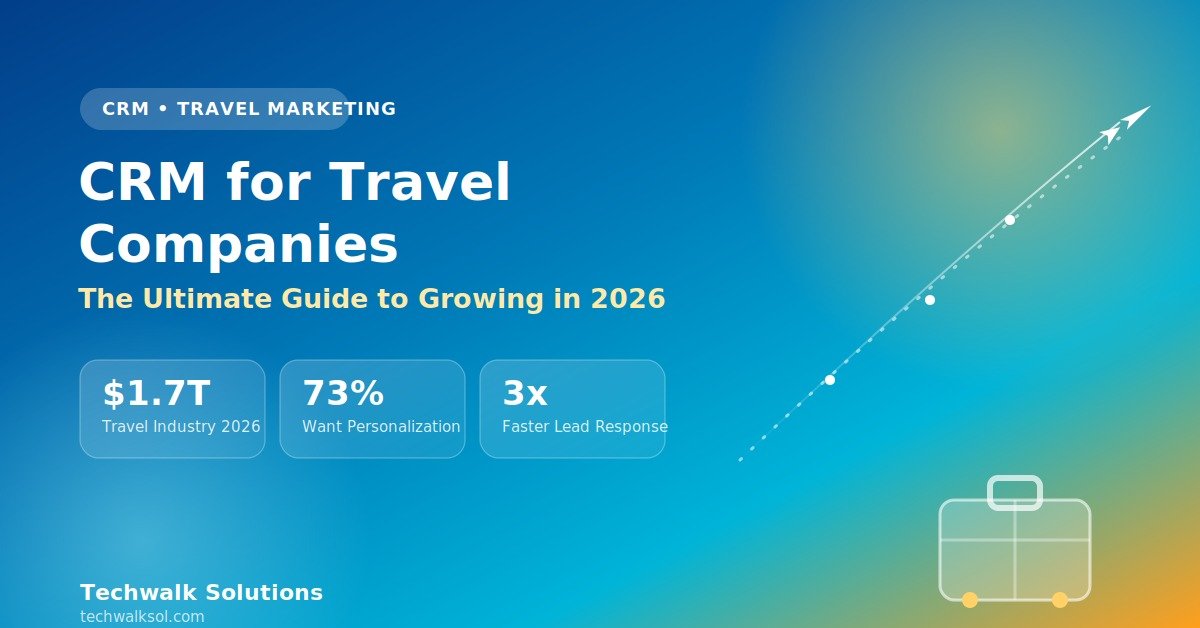
Every travel business owner knows the feeling: a returning client books through a competitor because you lost track of their preferences. Or a high-value lead goes cold because your team forgot to follow up. In a post-pandemic travel industry projected to exceed $1.7 trillion globally by 2026, the margin for such errors has essentially vanished. This is precisely why CRM for travel companies has shifted from a “nice-to-have” to a mission-critical tool. Whether you run a boutique travel agency, a large tour operator, or a hospitality group, the right Customer Relationship Management platform is the backbone of sustainable growth. In this guide, we’ll walk you through everything – what travel CRM software actually does, how to choose the right one, and why platforms like OneX CRM are purpose-built to help travel businesses compete and win in 2026.$1.7T Global Travel Industry 2026 | 73% Travelers Expect Personalization | 40% Revenue Growth (Case Study) | 3x Faster Lead Response |
1. What Is a CRM for Travel Companies?
A CRM (Customer Relationship Management) system for travel companies is specialised software designed to manage every touch point in the traveller’s journey, from the first inquiry to post-trip follow-up and repeat bookings. Unlike generic CRMs built for sales teams or e-commerce, travel CRM software is built around travel-specific workflows:- Managing itinerary preferences and past travel history
- Tracking leads from multiple booking channels (social, OTAs, direct)
- Automating follow-ups at key points in the booking funnel
- Segmenting clients by travel style, budget, and frequency
- Integrating with GDS systems, booking engines, and payment gateways
2. Why Travel Businesses Can’t Grow Without a CRM in 2026
The Problem: Fragmented Data, Lost Revenue
Most travel agencies still operate across disconnected tools – WhatsApp for client chats, spreadsheets for bookings, email for invoices, and sticky notes for follow-ups. This fragmentation costs the average travel business an estimated 23% of potential revenue annually due to missed follow-ups, duplicate work, and poor client experiences.The 2026 Reality: Travellers Expect Personalisation
A 2025 Salesforce State of the Connected Customer report found that 73% of travellers expect brands to understand their unique needs and expectations. They want personalised package recommendations, timely reminders, and seamless communication – across every channel they use. Without a centralised CRM, delivering this level of service at scale is impossible.The Solution: CRM as Your Growth Engine
With the right CRM for travel companies, your team can:- Respond to inquiries 3x faster using automated lead routing
- Increase repeat bookings by up to 35% through targeted campaigns
- Reduce manual admin work by 50%, freeing agents to focus on selling
- Track pipeline value in real-time and forecast revenue accurately
3. Key Features to Look for in the Best CRM for Travel Agency
3.1 Lead Management & Pipeline Tracking
Your CRM should capture leads from every source – website forms, social media, WhatsApp, email, and OTA platforms – and drop them automatically into a visual sales pipeline. Look for customizable stages that match your actual booking funnel.3.2 Client Profile & Travel History
Every client record should store: travel preferences, passport details, dietary restrictions, past itineraries, communication history, and upcoming trips. This is the engine of personalisation.3.3 Automated Follow-Up Sequences
The best CRM for tour operators includes pre-built automation workflows: inquiry acknowledgements, quote follow-ups, booking confirmations, pre-departure checklists, and post-trip review requests – all triggered automatically.3.4 Booking & Invoice Integration
Seamless connection to your booking engine, payment gateway, and accounting software eliminates double-entry and reduces errors significantly.3.5 Reporting & Revenue Analytics
Real-time dashboards showing conversion rates, revenue per agent, top booking sources, and client lifetime value are non-negotiable for data-driven growth.3.6 WhatsApp & Omnichannel Communication
In 2026, travel clients communicate via WhatsApp, Instagram DMs, email, and phone. Your CRM must unify all these channels into a single inbox.4. Step-by-Step: How to Implement Travel CRM Software Successfully
- Audit Your Current Process – Map every step from lead to repeat booking. Identify where leads fall through the cracks, where agents spend the most time on manual tasks, and where the client experience breaks down.
- Define Your Must-Have Features – Based on your audit, prioritise the top 5-7 features your team genuinely needs. Avoid over-engineering – start with what solves your biggest pain points.
- Choose a Travel-Specific CRM – Generic CRMs like HubSpot or Salesforce require heavy customisation for travel. Purpose-built platforms like OneX CRM come pre-configured with travel workflows, saving months of setup time.
- Migrate Your Data – Clean and import your existing client data – contacts, booking history, and communication logs. Most modern travel CRMs offer guided migration support.
- Train Your Team – A CRM is only as powerful as the team using it. Invest in proper onboarding, create internal SOPs, and designate a CRM champion in your organisation.
- Activate Automations Gradually – Start with 2-3 core automations (lead acknowledgement, quote follow-up, booking confirmation) and expand as your team gets comfortable.
- Review and Optimise Monthly – Set a monthly CRM review meeting: analyse pipeline health, automation performance, and agent activity. Use data to continuously refine your process.
5. Top Strategies to Use CRM for Tour Operators and Agencies
Strategy 1: Segment Clients by Travel Persona
Use CRM tags to segment clients into personas – adventure travellers, luxury seekers, family holiday planners, solo backpackers. This enables highly personalised marketing that converts at 2-3x the rate of generic campaigns.Strategy 2: Build Automated Re-Engagement Campaigns
Set up automated campaigns targeting clients who haven’t booked in 6-12 months. A personalised “We miss you” email with a curated package based on their travel history is remarkably effective.Strategy 3: Use Pipeline Scoring to Prioritise Leads
Not all leads are equal. Configure lead scoring in your CRM – assigning points for budget range, response speed, trip complexity, and referral source – so agents always focus on the highest-value opportunities first.Strategy 4: Create Post-Trip Loyalty Loops
After every trip, automate a thank-you message, a review request, and a “What’s next?” follow-up with 2-3 personalised package suggestions. This single workflow can increase repeat bookings by 25-30%.Strategy 5: Track Agent Performance Transparently
Use your CRM’s analytics dashboard to track conversion rates, response times, and revenue per agent. Healthy internal benchmarks motivate performance and identify coaching opportunities.6. Common Mistakes Travel Businesses Make with CRM
- Mistake 1: Choosing a Generic CRM
- Mistake 2: Poor Data Migration
- Mistake 3: Ignoring Mobile Access
- Mistake 4: Automating Too Aggressively Too Soon
- Mistake 5: No Accountability for CRM Adoption
7. Expert Tips from Industry Professionals
- Tip 1: Build your CRM around the client journey, not your internal org chart. Think like a traveller, not like an operations manager.
- Tip 2: Use your CRM’s API integrations to connect with WhatsApp Business, Google Workspace, and your payment gateway. Fragmentation kills efficiency.
- Tip 3: Review your email open rates and automation click-through rates monthly. Low engagement is a signal to rewrite, not to add more emails.
- Tip 4: The best CRM investment is training. Budget at least 20% of your implementation cost for team onboarding and ongoing coaching.
8. FAQ: CRM for Travel Companies
Q1: What is the best CRM for a travel agency in 2026?
The best CRM for travel agencies in 2026 combines lead management, client profiling, booking integration, and omnichannel communication. Platforms built specifically for travel – like OneX CRM – outperform generic tools because they require minimal customisation and match real travel workflows.
Q2: How does travel CRM software improve client retention?
Travel CRM software improves retention by tracking client preferences, automating personalised follow-ups, and triggering re-engagement campaigns. Agencies using CRM-driven retention strategies typically see 25-35% higher repeat booking rates.
Q3: Is CRM software useful for small travel agencies?
Absolutely. Small travel agencies benefit most from CRM – it replaces multiple disconnected tools, reduces manual work, and allows even a 2-3 person team to manage hundreds of leads professionally and efficiently.
Q4: Can a CRM for tour operators integrate with booking engines?
Yes. Modern travel CRMs integrate with major booking engines, GDS platforms, payment gateways, and WhatsApp Business APIs. Always verify integration compatibility before choosing a CRM platform.
Q5: How long does it take to implement a travel CRM?
Basic implementation takes 2-4 weeks, including data migration, team training, and automation setup. Full optimisation typically takes 60-90 days as your team refines workflows and client segmentation.
Q6: What is the ROI of implementing a CRM for a travel business?
Travel businesses typically see measurable ROI within 90 days – driven by faster lead response, higher conversion rates, and increased repeat bookings.
Q7: How does a travel CRM support WhatsApp and social media inquiries?
The best travel CRMs offer omnichannel inboxes that consolidate WhatsApp, Instagram DMs, email, and phone inquiries into one dashboard, ensuring no lead is missed, and all communication is logged automatically.
Conclusion
The travel industry has never been more competitive – or more opportunity-rich – than it is in 2026. Travellers are booking more, spending more, and expecting more. The businesses that will capture this growth are the ones that invest in the systems to manage client relationships at scale, with precision and personalisation.
CRM for travel companies isn’t just a software investment. It’s a commitment to building a business where no lead falls through the cracks, no client feels forgotten, and no revenue opportunity goes untapped.
OneX CRM was built specifically for travel businesses like yours – combining intelligent lead management, omnichannel communication, booking integration, and powerful automation into one platform designed to help you grow faster with less manual effort.