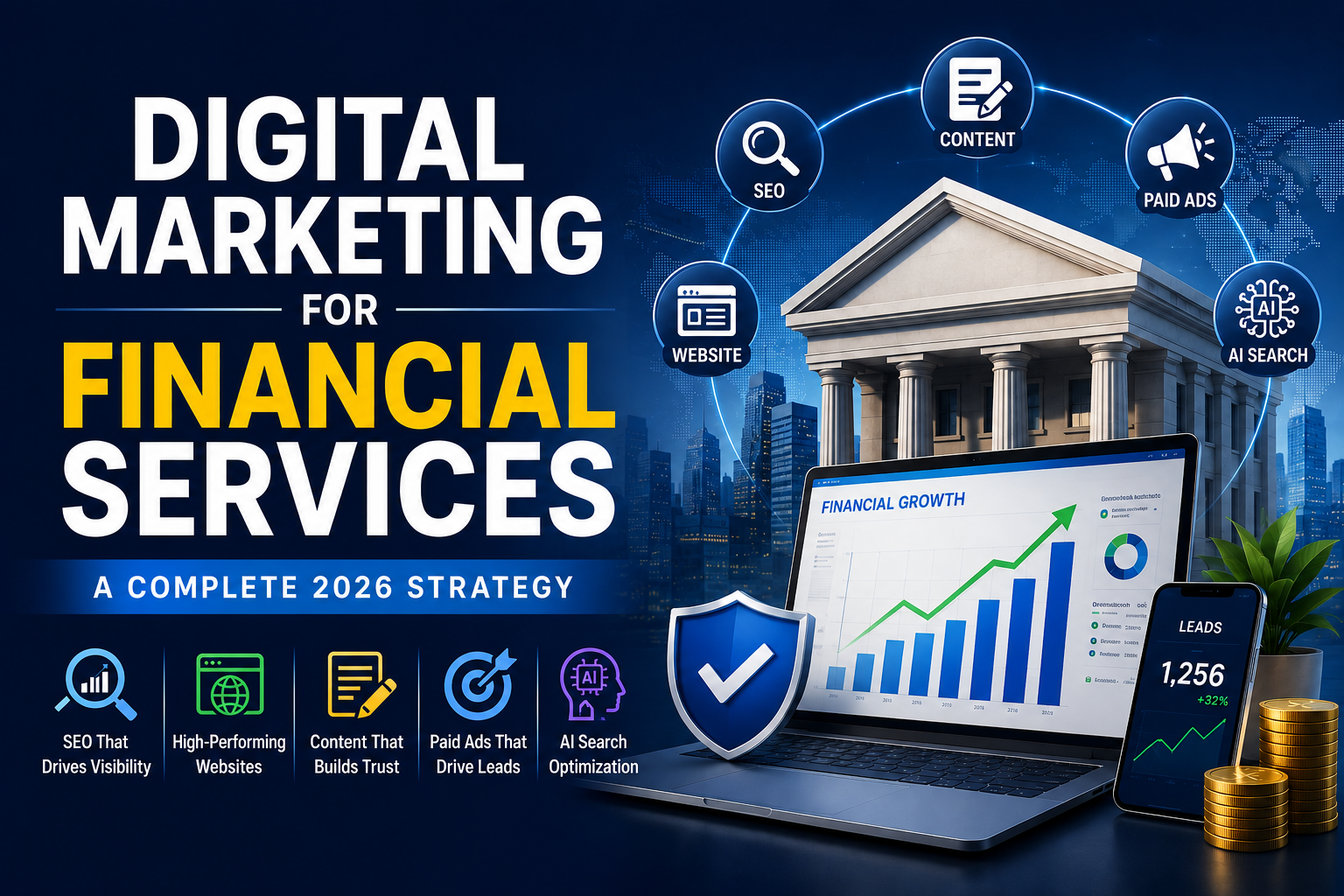
Financial services businesses face more online attention than almost any other industry. A prospective client comparing loan providers, insurance policies, or wealth management firms isn’t just looking for information; they’re deciding who to trust with their money. That’s what makes digital marketing for financial services different: visibility alone isn’t the goal. Credibility has to come through in every search result and page a business publishes.
For banks, NBFCs, insurance providers, credit unions, and fintech platforms, digital marketing for finance companies carries an added layer of responsibility. Regulatory sensitivity and the high-stakes nature of money decisions mean marketing has to educate first and sell second.
Why Digital Marketing for Financial Services Requires a Different Approach
People searching for financial products rarely convert on the first visit. They run several searches and compare multiple providers before making contact. This is often described as Your Money or Your Life (YMYL) territory, a category search engines treat with extra caution because the content can affect someone’s financial wellbeing.
That’s why trust signals carry more weight here than in most niches. Clear service descriptions, transparent contact information, a secure website experience, visible privacy information, and accurate about-us details all influence whether a business is seen as credible by visitors and search engines alike.
Building an SEO Strategy for Financial Services Companies
Search intent, not keyword volume, should be the starting point. “Best fixed deposit rates” wants comparison information. “How to apply for a business loan” wants a process explanation. A service plus a city wants a local provider. Each deserves a different page rather than one generic services list.
How SEO Helps Financial Services Companies Attract the Right Prospects
That comes down to mapping content to each stage of the search journey:
- Service pages built around what the customer needs to know, not just a product description
- Topic clusters, for example, a hub page on “home loans” linking to supporting pages on eligibility, documentation, and rate types
- Educational content answering questions prospects have before they’re ready to talk to sales.
- Local landing pages for businesses serving specific cities or regions
- Internal linking that connects related pages so search engines understand how services relate
Technical SEO for financial websites also deserves attention. Site speed, mobile usability, clean URLs, secure HTTPS, and structured data (schema markup) help search engines understand what a page covers. Financial content changes often- rates, terms, regulations- so a setup that makes updates easy matters more than one that only looks good on launch day.
Website Development for Financial Companies: Where Trust Starts
A financial-services website has to balance a professional, credible design with a genuinely easy experience. A confusing layout, slow load times, or unclear navigation pushes a cautious prospect straight to a competitor.
A user-friendly financial website typically includes:
- Clear, jargon-light explanations of products and services
- Simple navigation between services, resources, and contact options
- Fast-loading pages, especially on mobile
- Visible security indicators and privacy information
- Conversion-focused landing pages with one clear next step, such as a callback request or consultation booking
None of this replaces compliance requirements specific to a business’s licensing or region, but it creates the kind of digital experience that supports both trust and search visibility.
Content Marketing and Authority Building
Content is where financial businesses either earn trust or lose it. Thin content signals low expertise; useful, accurate, well-organised content signals the opposite.
This is how financial companies can build online authority over time: by publishing content that reflects real, first-hand understanding of the products offered, backed by clear explanations rather than vague claims. FAQs that answer real questions, guides that walk through processes, and pages that state plainly who a service is for, all add up to the topical depth that supports both rankings and AI-generated answers.
Paid Advertising for Financial Services Lead Generation
Paid search and social advertising remain useful for leads on a shorter timeline than organic growth allows. Campaigns need well-matched landing pages, since sending paid traffic to a generic homepage instead of a page built around the offer wastes budget. Ad copy carries extra responsibility here too, and claims need to be accurate.
Paid and organic work best together. SEO builds visibility over time; paid ads fill the gap while that visibility grows, and help test which offers actually convert.
AI Search Optimisation for Financial Services
Search behavior is shifting toward direct answers from AI Overviews, ChatGPT search, Gemini, Copilot, and Perplexity instead of a list of links. This shift means structuring content so these systems can understand and reference it accurately.
Practical steps include:
- Writing direct, clearly stated answers near the top of relevant sections
- Using question-based headings for common queries
- Keeping business information, name, services, location, contact details, consistent across the website and listings
- Structuring FAQs and service explanations so they’re easy to extract
- Building genuine topical depth, since generative systems tend to draw on sources that cover a subject thoroughly
None of this guarantees inclusion in any specific AI-generated answer. What it can do is improve the likelihood that these systems understand what a business offers and surface it as a relevant, trustworthy source.
Local and International Visibility
A business serving one city needs a different approach than one serving national or international clients. Local SEO, accurate business-listing information, and consistent name, address, and phone details help nearby customers find and trust a local provider. Businesses serving broader markets need clear signals about which regions they operate in, since a licensed service in one country may not be available in another, and structuring this clearly helps both users and search engines understand who it’s actually for.
What to Measure
Financial businesses are generally best served by watching organic visibility for priority service terms, qualified lead volume rather than raw traffic, landing page conversion rates, and cost per lead from paid campaigns. Analytics and CRM data together give a clearer picture than traffic alone.
Common Mistakes to Avoid
A few patterns show up repeatedly: treating the website as a brochure instead of a tool built around what prospects search for, publishing generic content that doesn’t reflect real expertise, sending paid traffic to pages that don’t match the offer, inconsistent business information across listings, and treating AI search as optional rather than part of the strategy.
Bringing It All Together
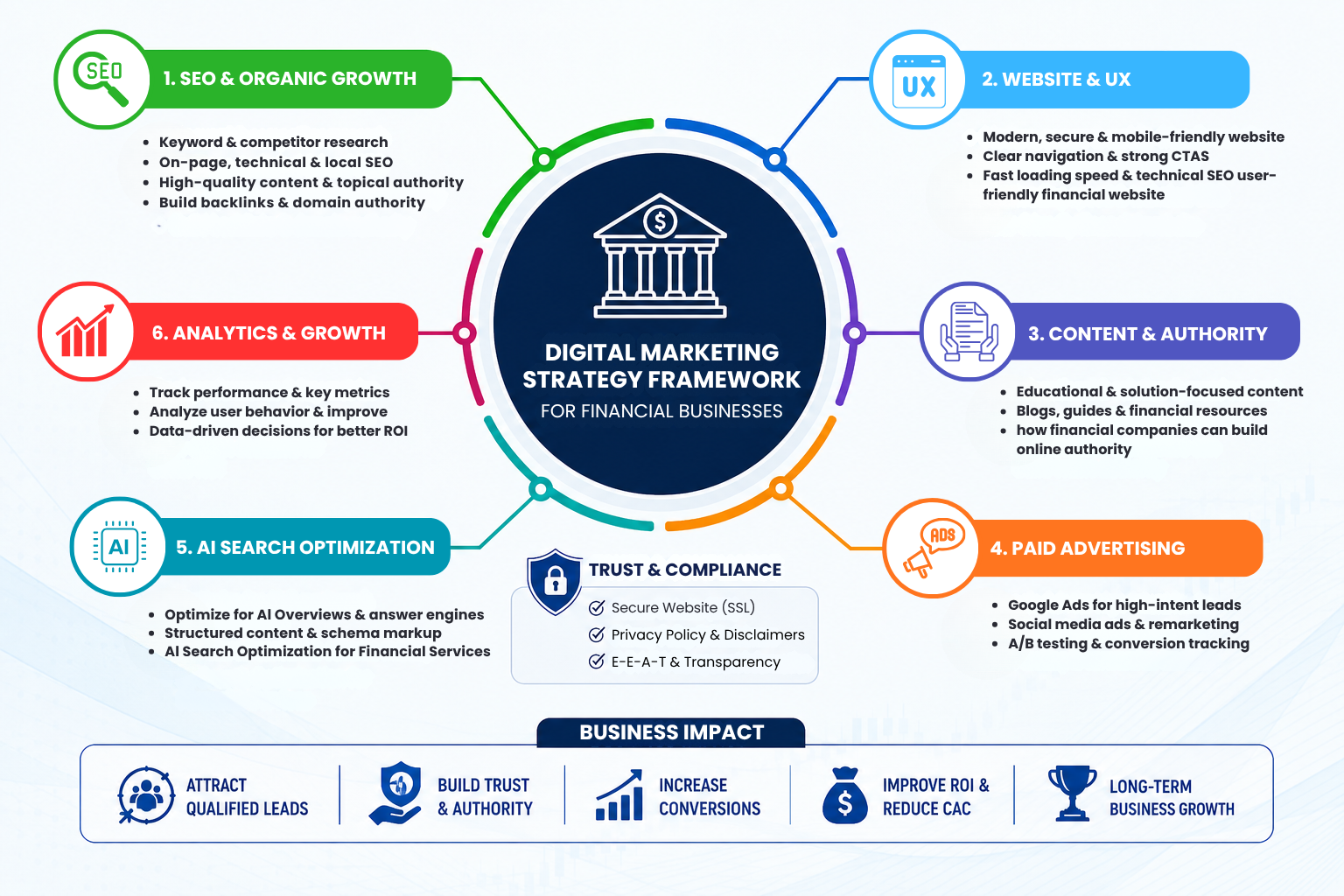
SEO, website experience, content, paid advertising, and AI search visibility aren’t separate projects; they support each other. A well-built website makes SEO more effective, strong content gives paid ads more credible landing pages, and consistent information helps AI search systems understand a business accurately. Approached this way, digital marketing for financial services becomes less about chasing tactics and more about building a consistent, trustworthy presence everywhere a prospect might look.
For businesses without the internal resources to manage this in-house, working with a digital marketing agency for financial services that understands both the compliance-sensitive nature of the industry and the technical demands of modern search can help close that gap, building the SEO, website, content, and AI-visibility foundations needed to compete in a search landscape that keeps changing.