
Quick answer: Travel agency lead management is the process of capturing every customer enquiry in one place, qualifying it, giving it one owner, following up on a schedule and tracking it through a pipeline until the customer books, declines or goes inactive.
The 7 steps: 1) capture every enquiry, 2) qualify it, 3) assign one owner, 4) follow up on a schedule, 5) track the pipeline, 6) measure results, 7) review lost leads.
Do you need a CRM? A spreadsheet can cope with a handful of enquiries a day. Once enquiries arrive from several channels, or more than one person handles them, a travel agency CRM saves bookings that would otherwise be lost.
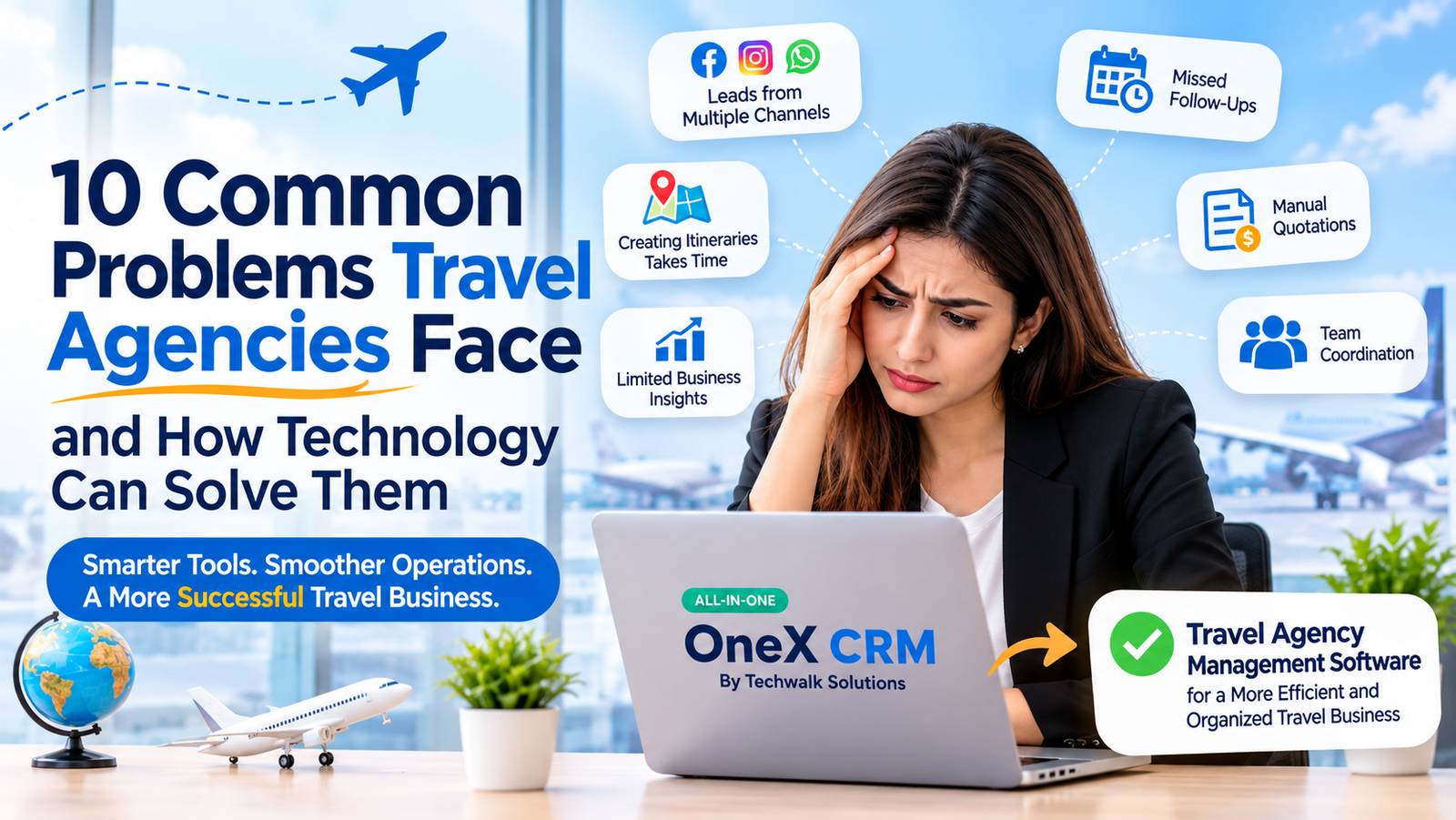
A couple asks about a Kerala honeymoon on Instagram, a family messages on WhatsApp about Dubai, and a company emails a group quote request. Four employees reply from personal phones, one enquiry is never picked up, and last week’s quotation has had no follow-up. Nobody can say how many bookings are likely this month. This guide shows how to fix that, with tables, scoring tiers, KPIs and message templates you can use today.
What Is Travel Agency Lead Management?
Travel agency lead management is the process of capturing, organising, qualifying, assigning, following up with and tracking potential customers until they book, decline or become inactive. It applies to travel agencies, tour operators, destination management companies (DMCs), visa consultants and holiday-package sellers.
In travel, a lead is anyone who has asked about a trip, package, visa or price, whether through a website form, phone call, WhatsApp, Instagram, Facebook, email or referral. Travel leads come with dates attached. A traveller flying in two weeks will book with whoever replies first, so slow handling costs you more than it would in most industries.
Why Do Travel Agencies Lose Leads?
Most lost enquiries come from a broken process, not a lack of demand. The common causes are:
- Scattered channels: enquiries sit in WhatsApp chats, Instagram inboxes, email and website forms.
- Slow replies: nobody noticed the enquiry arrive.
- Duplicate or missing owners: two agents contact one customer, or neither does.
- No follow-up after the quotation: the quote goes out and the trail goes cold.
- No prioritisation: serious buyers look the same as casual browsers.
- No visibility: managers cannot see who handles what, or how well.
How to Manage Travel Agency Leads: 7 Steps
Step 1: Capture every enquiry in one central record
Log every enquiry in one place, whatever channel it came from: website form, WhatsApp, Instagram, Facebook, email, phone call or referral. Record the source, the date and time received, and the customer’s name and number. Search by phone number before creating a record, so the same customer never appears twice. A simple rule works: if an enquiry is not in the central record, it does not exist.
Step 2: Qualify the lead before you quote
Lead qualification means understanding what the customer needs before you build a quotation. Capture these details:
- Destination and travel dates (fixed or flexible)
- Number of travellers, including children and seniors
- Budget range
- Trip type: honeymoon, family, group, adventure, business or pilgrimage
- Accommodation and transport preferences
- Expected decision date
Ask only what the quotation needs. Passport details can wait until the booking is confirmed.
Step 3: Assign one named owner
Every enquiry needs one owner, and ideally a named backup. Assign by availability, destination expertise, language, workload or enquiry type (for example, group and corporate leads to your senior sales representatives). This stops two employees calling the same customer and stops each assuming the other replied.
Step 4: Follow up on a schedule, not from memory
Set the next follow-up date every time you touch a lead. The timings below are a suggested starting point, not an industry rule. Shorten them for last-minute trips and stretch them for trips planned months ahead.
| Stage | Suggested timing | What to send or do |
|---|---|---|
| New enquiry | Acknowledge within the same working hour | Confirm you received it, ask for the missing details, and name the person who will help. |
| Requirement clear | Simple trips: within 24 hours. Custom or multi-country trips: 2 to 3 working days | Send the quotation or itinerary with a clear validity date. |
| Quotation shared | 1 to 2 days later | Check they received it and answer questions. |
| Considering | Every 3 to 4 days, each time with something new | Offer a revised hotel option, an availability change, a visa tip or a payment-plan choice. |
| Before the decision date | The day before | Send a polite reminder and say what happens if they wait (price or availability change). |
| Not ready | On the date the customer agreed | Record the reason and schedule a future contact. |
Follow-ups should be relevant, timely and respectful. A revised hotel option helps more than a third “just checking in”.
Step 5: Track every enquiry through a sales pipeline
A travel sales pipeline shows where each enquiry stands, so you can see which quotations are waiting and which leads have gone quiet. Rename or add stages to fit your own process.
| Pipeline stage | What it means | Next action |
|---|---|---|
| New enquiry | Received, not yet contacted | Acknowledge and assign an owner |
| Contacted | First reply sent | Collect requirements |
| Requirement qualified | Dates, travellers and budget known | Build the quotation |
| Quotation shared | Customer has the price | Follow up in 1 to 2 days |
| Follow-up pending | Customer is considering or negotiating | Send new information and agree a decision date |
| Booking confirmed | Advance payment received | Collect documents and hand over to operations |
| Lost, declined or inactive | No booking | Record the reason; schedule a future contact if appropriate |
Step 6: Measure lead sources and booking performance
Track the numbers below weekly or monthly. Compare like with like, because peak-season and last-minute enquiries behave differently from early planners.
| Metric | Formula | What it tells you |
|---|---|---|
| Enquiry-to-booking conversion rate | Confirmed bookings ÷ total enquiries × 100 | Overall sales effectiveness |
| Enquiry-to-quotation rate | Quotations sent ÷ total enquiries × 100 | How many enquiries you qualify and quote |
| Quotation-to-booking rate | Bookings ÷ quotations sent × 100 | Quality of quotes and follow-up |
| Average first-response time | Total time to first reply ÷ number of enquiries | Speed of response |
| Follow-up completion rate | Follow-ups done on time ÷ follow-ups due × 100 | Team discipline |
| Source conversion rate | Bookings from a source ÷ enquiries from that source × 100 | Which channels deserve more budget |
Worked example (illustrative numbers): 200 enquiries produce 120 quotations and 30 bookings. That is a 60% enquiry-to-quotation rate, a 25% quotation-to-booking rate and a 15% overall conversion rate. If the first rate is low, the problem is qualification and speed. If the second is low, look at pricing and follow-up.
Step 7: Review the pipeline and lost leads every week
Hold a 20-minute weekly review. Check overdue follow-ups, quotations older than a week with no reply, and every lead marked lost. Tag each lost lead with a reason: price, dates, chose another agent, no response, or trip cancelled. After a month, the reasons show you what to fix.
How Do You Score Travel Leads as Hot, Warm or Cold?
Scoring lets you spend the first hour of the day on the enquiries most likely to book. A three-tier system is enough for most agencies. Re-rate a lead whenever new information arrives.
| Tier | Typical signals | How to handle |
|---|---|---|
| Hot | Fixed dates, travellers confirmed, budget stated, travelling soon, asks about availability or payment | Same-day call and quotation; senior owner |
| Warm | Destination and rough dates known, comparing options, asks for alternatives | Standard quotation timing; regular follow-ups with new options |
| Cold | Gathering ideas, no dates or budget, travel is months away | Send an inspiring package or guide; revisit on a set future date |
Follow-Up Message Templates for Travel Enquiries
Adapt these to your own voice and replace the details in brackets.
First response (WhatsApp or email): “Hi [Name], thank you for asking about [destination]. I am [your name] and I will help you plan this trip. To prepare an accurate quotation, could you confirm your travel dates, the number of travellers and your approximate budget?”
After the quotation: “Hi [Name], I shared the [destination] itinerary yesterday. Have you had a chance to look at it? I can adjust the hotel or the activities if you would like a different option.”
Before the decision date: “Hi [Name], the hotel rate in your quotation is held until [date]. If you would like to go ahead, I can confirm it today. If you need more time, tell me and I will check what is possible.”
What Are the Most Common Lead Management Mistakes?
- Keeping leads in personal phones. The enquiry leaves the company when the employee does. Fix: log everything centrally.
- Treating all leads equally. Fix: score leads and prioritise hot ones.
- Sending a quote with no next step. Fix: schedule the follow-up before you send it.
- Over-asking at first contact. Fix: ask only what the quote needs.
- Chasing with the same message. Fix: every follow-up should add something new.
- Never recording why leads were lost. Fix: make a reason mandatory when closing.
Spreadsheet, WhatsApp or Travel CRM: Which Should You Use?
Use the simplest tool that still gives you one record, one owner and a next action for every lead. This comparison shows where each option breaks.
| Personal WhatsApp / phones | Spreadsheet | Travel agency CRM | |
|---|---|---|---|
| Best for | One-person agencies, very low volume | A few enquiries a day, one or two users | Several channels and team members |
| Multi-channel capture | No, each chat is separate | Manual entry | Centralised dashboard (varies by product) |
| Follow-up reminders | None, relies on memory | Manual, easy to miss | Automatic reminders and alerts |
| Ownership | Unclear | Needs discipline | Assigned and visible |
| Reporting | None | Manual formulas | Built-in source and team reports |
| Main risk | Lost leads, lost history | Stale rows, version clashes | Cost and setup time |
Signs you have outgrown spreadsheets: enquiries arrive from three or more channels; more than one person handles customers; you have missed a follow-up this month; you cannot say how many quotations are pending; or you do not know which source produces bookings.
How Can Travel CRM Software Simplify Lead Management?
A travel agency CRM brings capture, assignment, follow-up, quotation and reporting into one system, so the seven steps above run from one screen instead of five apps. TechWalk Solutions’ travel CRM software, OneX CRM, is built for this. According to its product page, it includes:
- Smart lead management: leads from Facebook, Instagram, WhatsApp, email and Google Sheets on a central enquiry dashboard, with lead assignment and tracking.
- Follow-up and query management: reminders, alerts for unattended queries and a communication history for each customer.
- Itinerary and quotation builder: quotations and itineraries with automatic tax and total calculations, plus multi-currency quotes with conversion and markup management. Itineraries can be shared by email, WhatsApp or SMS.
- Customer and booking management: a central customer database with booking history and preferences.
- Reporting and analytics: daily sales and activity reports, lead-source tracking and team-performance reports.
- Team tools: user roles, attendance, a schedule tracker and a mobile-friendly interface.
Who it suits: the product page lists travel agencies, tour operators, DMCs, visa consultants, holiday-package providers and corporate travel companies, from startups to large agencies.
Pricing (as listed on the product page in November 2026, so confirm before you buy): the first-year plan is ₹20,000 per year and includes three users, setup and onboarding, access to the built-in learning system, technical support and basic customisation support. Additional users cost ₹499 each.
A fair caveat: software organises the work. It does not win bookings by itself, because conversion also depends on pricing, packages, communication and sales execution. The product page does not list integrations with GDS or accounting systems, so ask about those in the demo if you need them.
What Should You Look for in a Travel Agency CRM?
Check these six things before you commit to any travel CRM, whether OneX CRM or another:
- Does it capture enquiries from the channels you actually use, including WhatsApp and social media?
- Can every lead have one owner, a status and a next follow-up date?
- Does it include a quotation and itinerary builder in the currencies you sell in?
- Does it report on lead sources, conversion and team performance?
- Is it easy for your team to use on a phone, and does the vendor provide onboarding and support?
- Is pricing clear, including the cost of extra users and any customisation?
Build a More Organised Travel Agency Sales Process
Capturing, qualifying, assigning, following up and tracking every enquiry shows you what is open, what is waiting on the customer and what has closed. Start with the process, then choose the tool that fits it. If you want one place for travel enquiries, quotations and customer history, explore OneX CRM or book a demo to see whether it fits your workflow.
Frequently Asked Questions
What is travel agency lead management?
It is the process of capturing every travel enquiry, qualifying it, assigning it to one owner, following up on a schedule and tracking it until the customer books, declines or becomes inactive.
What is the best way to manage travel agency enquiries?
Keep every enquiry in one central record, give it one owner, qualify it, set a follow-up date and move it through clear pipeline stages. Review overdue follow-ups every week.
How can travel agencies manage leads from WhatsApp and social media?
Record each WhatsApp, Instagram or Facebook enquiry in one central system with its source, owner and status. A CRM can capture some channels automatically. Support differs by product, so check which channels it connects to directly.
How quickly should a travel agency respond to an enquiry?
Reply as fast as you can, ideally within the same working hour, even if it is only an acknowledgement and a request for missing details. This is a suggested target, not an industry rule. Last-minute trips need a faster response than trips planned months ahead.
How often should I follow up after sending a travel quotation?
A reasonable starting point is 1 to 2 days after sending the quotation, then every 3 to 4 days with new information until the decision date. Adjust to the travel date and the customer’s stated timeline, and stop when they decline.
What is a good conversion rate for a travel agency?
There is no single reliable benchmark, because conversion depends on the trip type, season, lead source and pricing. Measure your own enquiry-to-quotation and quotation-to-booking rates monthly and compare against your own earlier results.
Do small travel agencies need a CRM?
Not always. A well-kept spreadsheet works for a few enquiries a day with one or two users. A CRM becomes worthwhile when enquiries come from several channels, several people handle leads, or you start missing follow-ups.
How much does a travel CRM cost in India?
Prices vary by number of users, features and onboarding. As an example, OneX CRM’s product page lists ₹20,000 for the first year with three users and ₹499 for each additional user. Confirm the current price with the vendor.
Can CRM software help travel agencies convert more enquiries into bookings?
It can improve organisation, response consistency, follow-up visibility and reporting. Results still depend on pricing, packages, customer requirements and sales execution.