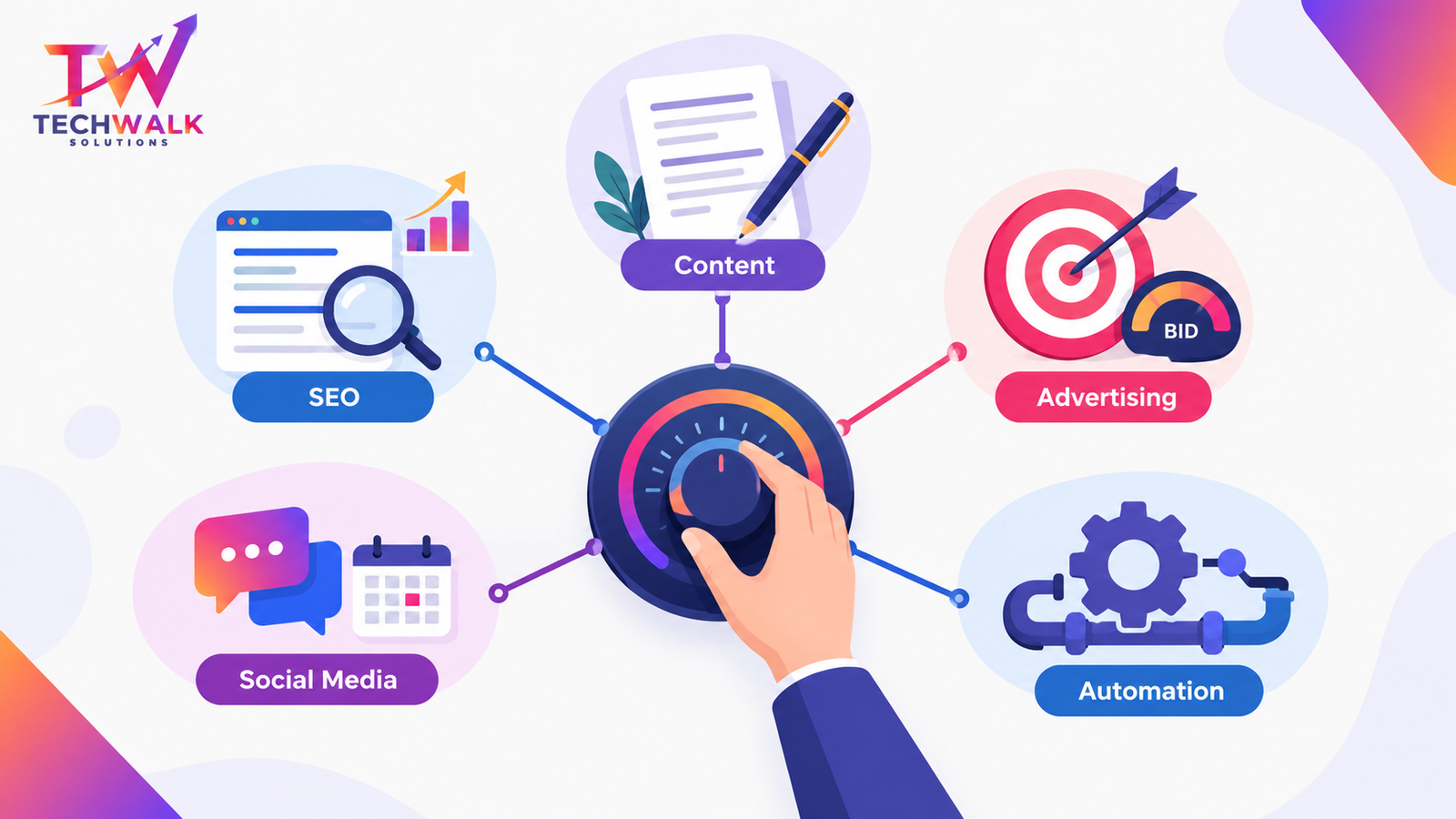
Marketing teams are expected to publish useful content, manage search and social channels, run paid campaigns, follow up every enquiry and prove the budget is working, often with only a handful of people. AI in digital marketing can take on part of that load by supporting research, data analysis, personalization, content production and repetitive workflows. What it cannot do is replace strategy. It performs best when pointed at a clear problem, fed reliable data and checked by someone who knows the business. This guide shows where AI fits across SEO, content, advertising, social media and automation, and how to start without wasting time or money.
What Is AI in Digital Marketing?
Artificial intelligence in digital marketing means using software that learns from data, or generates material from instructions, to support marketing work. Four terms are often mixed up:
- Machine learning: finds patterns in data, such as which visitors resemble people who later enquire.
- Generative AI: creates text or images from prompts, such as an outline or ad headline options.
- Predictive analytics: estimates likely outcomes from past data, such as which leads may convert.
- Automation: runs defined steps without manual effort, such as a confirmation email after a form submission.
Consider a physiotherapy clinic. It could group patient questions for content planning, summarize which campaigns led to booked appointments and sort new enquiries by treatment type. Each step saves time, but results still depend on what the clinic publishes, how it verifies health information and what it does with the data.
How AI Is Used in Digital Marketing
AI for SEO and Search Visibility
The most dependable role for AI in SEO is research and analysis assistant. It can cluster keywords, compare what competing pages cover, flag outdated pages during a content audit, draft briefs and help interpret crawl reports to surface issues such as broken links. A person still decides which topics fit the business and its customers.
Supporting SEO work is different from publishing pages AI generates automatically. Google’s guidance says generative AI can help with researching a topic and structuring original content, but producing many pages without adding value may breach its spam policy on scaled content abuse. Pages need original insight, accurate information and editorial review, on a crawlable site built with solid website design and development.
For AI-powered search, Google says a page must be indexed and eligible to appear with a snippet before it can be a supporting link in AI Overviews or AI Mode. Ordinary SEO fundamentals still apply, and no special markup is required. Nothing guarantees inclusion, but Search Console reports on generative AI features, so you can measure. For hands-on help, see TechWalk’s SEO services in Chandigarh.
AI for Content Marketing
AI can speed up topic research, outlines, headline alternatives, content updates and repurposing. One workflow suits most teams:
- Collect real customer questions from sales calls, emails and search data.
- Ask AI to group them by theme, then pick those your business can answer best.
- Outline the article and add what only you know: pricing ranges, your process, real examples.
- Use AI for a first draft, then verify every statistic and claim against a source.
- Edit for brand voice, have a subject expert approve it, then repurpose it into social posts.
Human review is not optional. Google’s guidance on generative AI content stresses checking machine-written material for accuracy before publication. For product comparisons, read our guide to the best AI tools for digital marketing in 2026.
AI for Google Ads and Paid Advertising
Outside the ad platform, AI can analyze exported campaign data, group search terms to find wasted spend and suggest copy variations. Inside it, features such as Google’s Performance Max and AI Max for Search campaigns, and Meta’s Advantage+ tools, automate parts of matching, bidding, placements and creative variation.
These features depend on your inputs. Google’s help documentation says AI Max’s search term matching relies on signals from automated bidding such as Maximize Conversions, and recommends conversion-based bidding. If the account counts page views instead of form submissions or calls, automation optimizes toward the wrong goal. Relevant creative, clear objectives and regular checks of search terms and lead quality matter just as much. A small budget with little conversion data may need tighter manual control first.
AI in Social Media Marketing
AI can draft content calendars and captions, suggest creative angles, summarize audience insights, sort comments into questions, complaints and praise, and turn a blog post into a week of posts. The output still needs shaping: LinkedIn, Instagram and WhatsApp call for different formats, and in a multilingual market like India, language and regional sensitivities matter. For planning and publishing support, explore TechWalk’s social media marketing services.
How AI Marketing Automation Helps Businesses
Automation connects the repetitive steps between marketing and sales. Typical uses include:
- Capturing and organizing incoming leads
- Categorizing enquiries by service or intent
- Sending appropriate follow-up messages
- Updating CRM records and preparing campaign reports
- Notifying sales teams about high-priority enquiries
For example, a visitor submits a website redesign enquiry. The form sends the details to the CRM, tagged with the traffic source. An AI step labels it as a redesign project with a deadline and marks it high priority. The CRM sends an acknowledgement, assigns the lead to the web projects specialist and alerts them, and that person checks the classification before replying.
Handle data carefully: obtain consent, collect only what you need, limit access, keep records accurate and follow applicable laws such as India’s Digital Personal Data Protection Act, 2023 and the GDPR. Not every business needs this; a company with twenty enquiries a month may only need a form that emails the right person.
Benefits and Limitations of AI in Digital Marketing
Potential benefits: faster research, less repetitive work, quicker campaign analysis, scalable content workflows and better use of existing data.
Limitations: AI can state incorrect facts confidently, produce generic copy, reflect biased or incomplete data, raise privacy concerns, break after platform changes and add integration costs. All of it calls for human review.
None of this means AI automatically increases traffic, leads or revenue. Results depend on strategy, execution and measurement.
How to Start Using AI in Digital Marketing
- Identify one specific bottleneck, such as slow enquiry follow-up or time-consuming reporting.
- Choose a tool or built-in platform feature that addresses it before paying for anything new.
- Define the outcome and a baseline metric so you can compare.
- Test on a small scale, such as one campaign or five articles, and review every output.
- Measure, refine and expand only when it proves useful.
The right metric depends on the task: qualified leads, cost per lead and conversion rate for advertising and enquiries; organic clicks in Search Console for SEO; hours saved for reporting; campaign ROI for overall return. Saving time while lowering lead quality has not helped.
Guided by clear objectives, AI can support SEO through research and audits, content through faster drafts, advertising through sharper analysis, social media through planning, and automation through quicker lead handling. The common thread is human judgment: someone sets the goal, supplies good data, checks the output and measures the result. If you would like help with strategy or implementation, you are welcome to explore TechWalk Solutions’ digital marketing services.
Frequently Asked Questions
How is AI used in digital marketing?
AI supports research, content drafting, personalization, campaign analysis, audience segmentation and workflow automation such as lead routing and reporting. It handles preparatory or repetitive work, while people make strategic and brand decisions.
Can AI replace digital marketing professionals?
No. AI speeds up tasks, but it does not understand a business’s customers, goals or reputation like an experienced marketer. Strategy, quality control and accountability still need people.
Is AI useful for small businesses with limited budgets?
Yes, when used selectively. Many can start with AI features inside tools they already use, or free plans where offered, for drafting outlines or organizing enquiries. Plans and limits change, so check current terms first.
How can businesses use AI for SEO and Google AI Overviews?
Use AI for research, audits and briefs, then publish original, accurate content that helps readers. Google says SEO fundamentals still apply to AI Overviews: pages must be crawlable, indexed and snippet-eligible. Inclusion cannot be guaranteed, but you can monitor performance in Search Console.