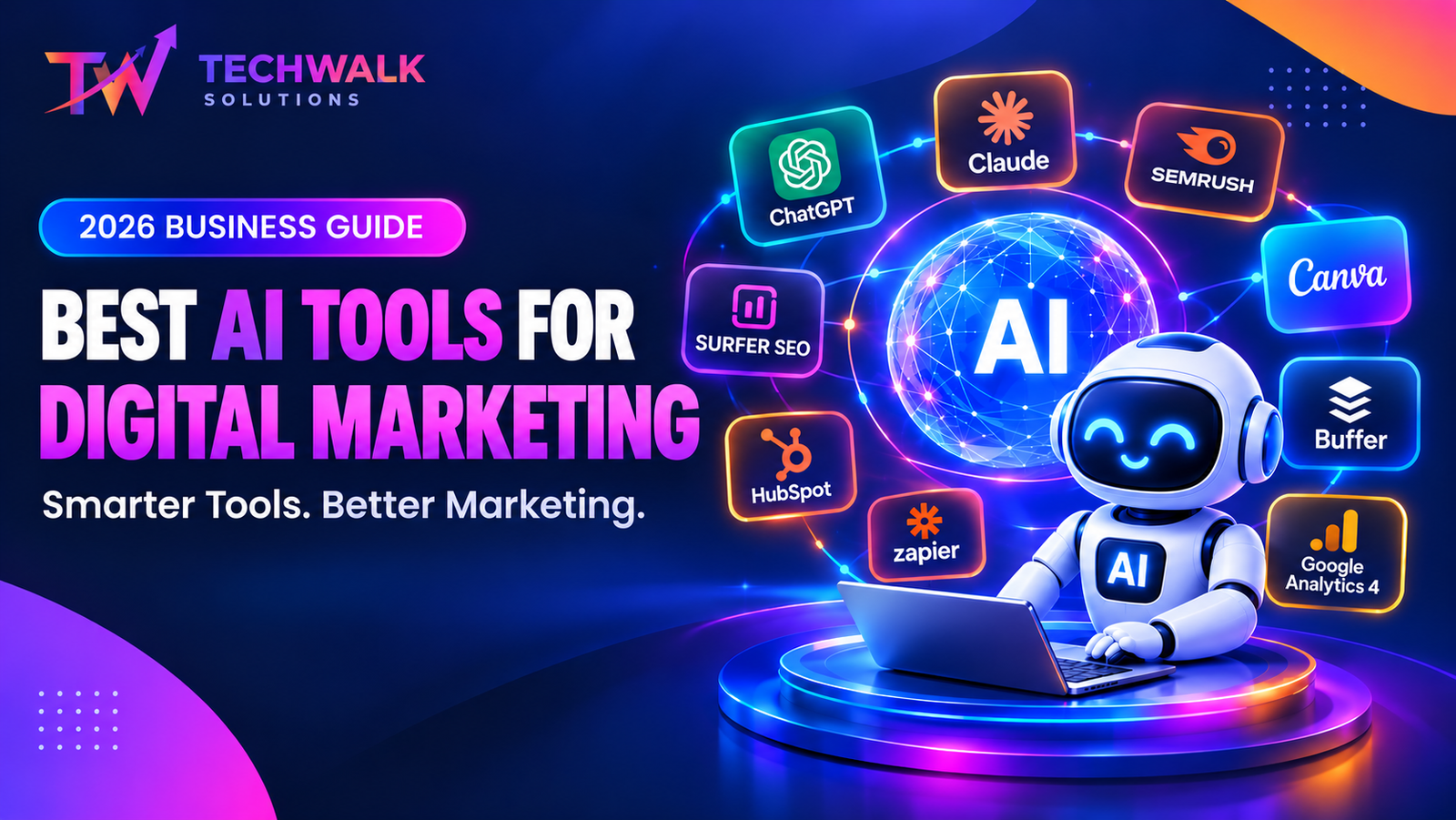
A five-person marketing team can plan campaigns, but it rarely has the hours to write every email, resize every graphic and compile every report. That gap is why choosing the best AI tools for digital marketing in 2026 matters, provided each tool removes a defined task instead of adding another login.
The short answer: most small businesses need one general AI assistant, one SEO tool, one design or scheduling tool and a way to connect them, not ten subscriptions. Below are nine tools grouped by job, with strengths, limits and pricing notes.
What Are AI Tools for Digital Marketing?
AI tools for digital marketing are software products that use machine learning or generative AI to draft content, analyze data, schedule posts or automate repetitive steps. They shorten preparation and routine work. Strategy, fact-checking and brand judgment still belong to people.
Two types are worth separating. General-purpose assistants such as ChatGPT, Claude and Google’s Gemini handle many tasks but lack your ranking and ad data unless you supply it. Specialist platforms such as Semrush, HubSpot and Buffer hold marketing data, so their AI works from real numbers.
Best AI Tools for Digital Marketing in 2026
Prices are in US dollars, checked against vendor pages or recent 2026 reviews, and vary by region and plan. Confirm on official pricing pages before buying.
| Tool | Best use case | Ideal user | Key consideration |
|---|---|---|---|
| ChatGPT | Drafting, ideation, research | Anyone starting with AI | Needs fact-checking; Free and Go may show ads |
| Claude | Long-form writing, editing, analysis | Content and strategy teams | Usage limits can interrupt long tasks |
| Semrush | Keyword research, audits, competitor data | SEO teams, agencies | Costly for beginners |
| Surfer SEO | On-page optimization | Teams publishing regularly | Follows existing results; no free plan reported |
| Canva | Social graphics, banners | Non-designers | Looks generic without a brand kit |
| Buffer | Scheduling, AI captions | Small social teams | Free plan is limited |
| HubSpot | CRM, email, lead follow-up | Teams already using HubSpot | Value depends on using its ecosystem |
| Zapier | Connecting apps, automation | Teams with repeat tasks | Usage is counted in tasks |
| Google Analytics 4 | Traffic analysis, predictive metrics | Any site owner | Predictions need enough purchase data |
AI Tools for Content and Copy
ChatGPT and Claude cover first drafts, ad variants, email copy and research summaries. ChatGPT has a free plan, and OpenAI lists Go at $8 and Plus at $20 a month in the US, adding that Plus stays ad-free. Claude also has a free plan, with paid tiers on its pricing page. Neither tool verifies facts, so check every statistic before publishing.
AI Tools for SEO and Content Optimization
Semrush combines keyword research, site audits and competitor analysis, and its AI Toolkit tracks how a brand appears in answers from ChatGPT, Google AI, Gemini and Perplexity. Recent reviews list the Pro plan at $139.95 a month, or $117.33 billed annually, per the Semrush pricing page.
Surfer SEO scores a draft against pages already ranking for a keyword and suggests missing subtopics. No permanent free plan was reported, and because it learns from existing results, it cannot supply a fresh angle. See Surfer’s pricing.
AI Tools for Design and Social Media
Canva suits non-designers. Its free plan includes some AI features, and paid plans started at $12 a month billed annually in Zapier’s June 2026 review. Upload your brand kit first, or outputs drift toward generic. Buffer is a scheduler first; its free plan includes an AI Assistant for captions, with limited channels, and paid plans are priced per channel. For campaign ideas, see our Facebook and Instagram marketing strategy guide.
AI Tools for CRM, Automation and Analytics
HubSpot offers a free CRM with some AI features; the benefit grows mainly when contacts and campaigns already live there. Zapier’s review lists paid plans from $45 per user per month, billed annually.
Zapier connects more than 9,000 apps. Its Free plan covers 100 tasks a month with two-step workflows, and Professional starts at $19.99 a month. Google Analytics 4 is free and includes predictive metrics such as purchase probability, though Google requires purchase events and eligible data before they appear.
How to Choose the Right AI Marketing Tools for Your Business
Zapier’s research found that 26% of professionals already cite overlapping tools as a barrier to value. Test any tool against these questions first:
- Goal: which task will it replace, and how many hours does that task take now?
- Budget: add subscriptions, extra seats and usage overages.
- Integrations: does it connect to your CRM, website and ad accounts?
- Privacy: what happens to customer data you upload?
- Oversight: who reviews output before customers see it?
- Outcome: which metric, such as cost per lead, will show it worked?
On a tight budget, start with free plans from ChatGPT or Claude, Canva and Google Analytics 4. Our digital marketing guide for small businesses in India shows how they fit alongside SEO and ads.
How Businesses Can Use AI Marketing Tools Effectively
Here is an illustrative workflow for a service business publishing one article a week:
- Research: pick a topic with clear buyer intent using Semrush or a free keyword tool.
- Plan: build an outline from your notes and customer questions.
- Draft and check: add your expertise, then verify every claim.
- Optimize: use Surfer or Semrush suggestions only where they help readers.
- Distribute: design graphics in Canva and schedule posts in Buffer.
- Review: check Google Analytics 4 and HubSpot weekly, then adjust.
A person should approve anything customer-facing, because AI output can be generic or wrong.
Are AI Marketing Tools Worth It for Small Businesses?
Yes, when a tool replaces a recurring, measurable task. Captions, report summaries and graphic resizing are good candidates. They are not worth it when they duplicate something you already own. If HubSpot already writes your emails, a separate AI email tool adds cost without much gain. Track hours saved or cost per lead for 60 to 90 days before upgrading.
The best AI tools for digital marketing in 2026 are the ones that remove a specific task from your week and show a measurable result. Start with one tool, set a baseline, and add another only when the first has earned its place. If you want help building a workable stack, Techwalk Solutions digital marketing services team can review your goals, budget and current tools.
Pricing and features last checked: October 2026.
Frequently Asked Questions
Q.1 What is the best AI tool for digital marketing in 2026?
There is no single best tool. ChatGPT or Claude suits drafting, Semrush suits SEO research and Canva suits design. Choose by the task you need to speed up.
Q.2 Can AI tools replace digital marketing professionals?
No. They automate drafts and routine analysis, but strategy and quality control need experienced people.
Q.3 Are free AI marketing tools enough for beginners?
Often yes. Free plans from ChatGPT, Claude, Canva, Buffer and HubSpot cover learning and light use. Upgrade when limits block real work.
Q.4 Is it safe to upload customer data to AI tools?
Not by default. Review vendor data settings, remove personal details and check obligations under laws such as India’s DPDP Act 2023.