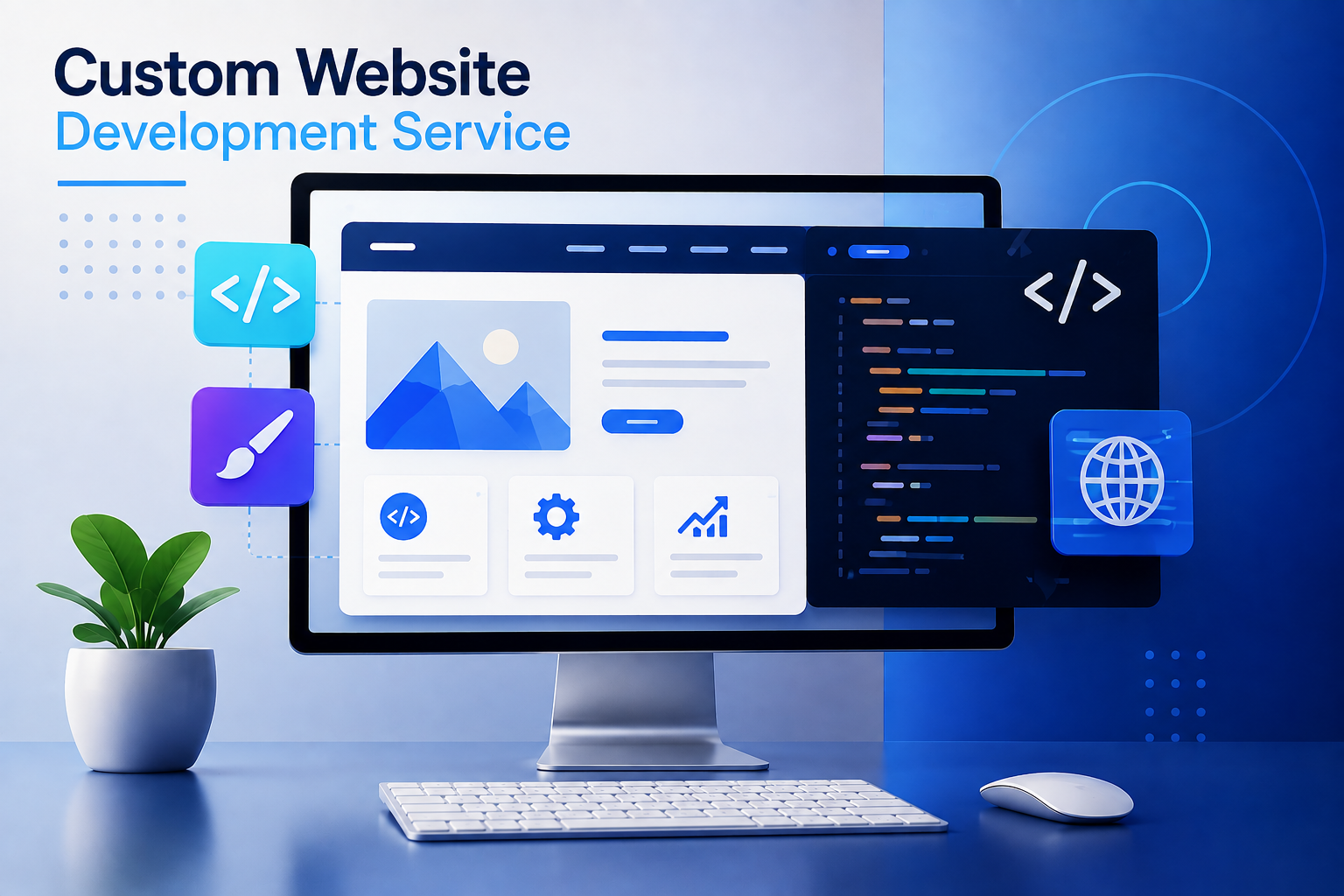
A good-looking website isn’t enough anymore. In 2026, visitors expect pages that load instantly, work smoothly on mobile, and guide them toward a decision within seconds – and search engines expect much the same before they’ll rank you highly. This is where a custom website development service makes the real difference between a site that simply exists online and one that actively brings in business. Instead of forcing your company into a pre-built template, custom development is built around how your business actually operates – your products, your sales process, and your customers – so the website works as a growth tool, not just a digital brochure.
What Does Custom Website Development Actually Involve?
Custom website development is the process of building a website around your specific business needs, rather than adapting a ready-made template to fit. A developer starts with your goals and customer journey, then writes the front-end code – HTML, CSS, and JavaScript – and connects it to a back end: a database, a content management system (CMS), or custom APIs, structured for how your business actually runs.
This is different from picking a theme off a marketplace and swapping colours and logos. Template sites are quick and inexpensive, but they come with someone else’s code and assumptions about structure, plus a fair amount of bloat you’ll never use. Custom development starts with the business first and builds the technology around it.
Why Choose a Custom Website Development Service for Your Business?
Off-the-shelf templates work fine for very simple use cases. But once a business has specific processes – a booking system, a quote calculator, a membership area, an inventory-linked store – templates tend to work against you instead of for you. A few reasons businesses move to custom development:
- Business-specific functionality and scalability – built for your workflow, and able to grow without a rebuild.
- Better UX/UI and performance – layout designed around real browsing behaviour, with no template bloat.
- Security and SEO flexibility – fewer generic vulnerabilities, plus full control over URLs, metadata, and technical SEO.
- Conversion optimisation – forms and checkout flows refined without plugin limitations.
- Third-party integration – CRMs, payment gateways, and marketing tools connect via APIs built for your stack.
What Makes a High-Performance Business Website?
“High-performance” isn’t just a marketing phrase – it refers to measurable things.
- Fast loading speed – every extra second of delay raises the chance a visitor leaves early.
- Mobile-first design – the mobile version is effectively what Google ranks, under mobile-first indexing.
- Clear, conversion-focused navigation – visitors and crawlers find pages quickly, with CTAs placed where people naturally look.
- Secure, clean architecture – SSL/TLS and well-structured code that’s easy to update and treated as a ranking signal.
- Accessibility – works with screen readers and keyboard navigation.
- Analytics and tracking – Google Analytics and Search Console configured so decisions are data-led.
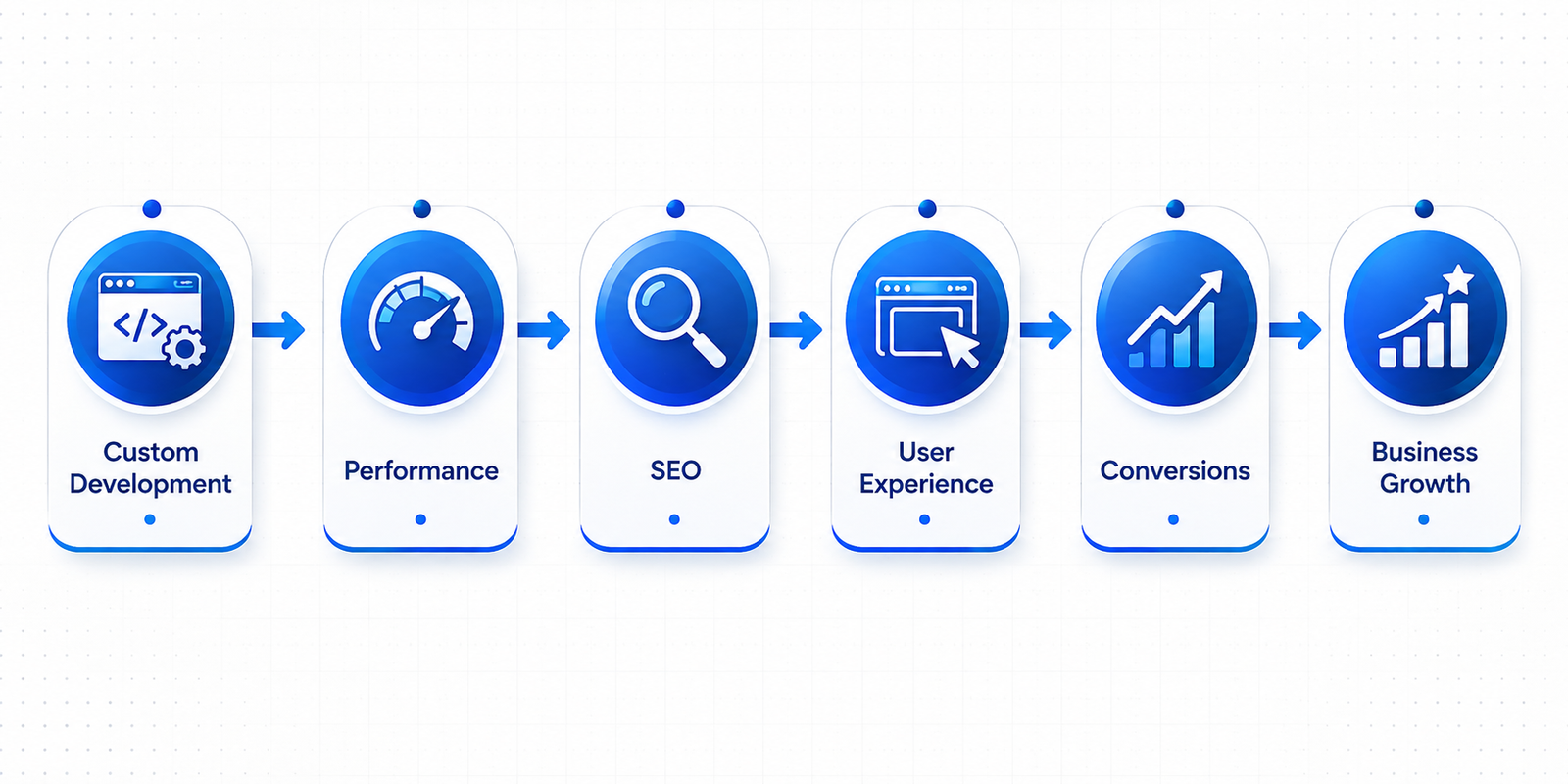
How Website Development Supports SEO and AI Search
Development and SEO aren’t separate disciplines – the way a site is built determines how well it can rank. This is technical SEO development: making sure a site’s underlying code and structure help search engines and AI systems understand and trust the content. Key pieces include:
- Core Web Vitals – Google’s measures of loading speed, interactivity, and visual stability.
- Crawlability and indexability – clean URLs, sensible internal linking, and an accurate sitemap.
- Structured data and schema markup – tells search engines what a page is about, improving eligibility for rich results.
- Mobile usability and semantic content – responsive layouts and clearly organised copy AI tools can extract answers from.
That last point matters more each year. AI Overviews, ChatGPT, and similar tools tend to pull answers from pages that state information clearly with context – the basis of answer engine optimisation (AEO) and generative engine optimisation (GEO). Messy markup gives these systems little to work with; clear structure gives them something worth citing.
How a Custom Website Development Service Supports Business Growth
A website’s job isn’t to sit online looking presentable – it’s to move visitors toward a decision. A properly developed custom website development service supports growth in a few concrete ways:
- Lead generation and sales – CTAs and checkout flows placed and built to reduce drop-off.
- Brand credibility – a fast, secure, well-built site signals legitimacy immediately.
- Customer experience – clear information architecture reduces friction and support queries.
- Organic visibility – strong technical SEO gives content a genuine chance to rank.
None of this happens automatically. It comes from decisions made during development – how pages are structured, how fast they load, how the CMS is set up so a content team can actually use it.
Custom Website Development for Local and Global Businesses
Requirements shift depending on who a business is serving. A local business – a clinic, a retail chain, a service provider – usually needs location pages, local schema markup, and content written for a specific city or region. A business investing in custom website development in Chandigarh, for instance, typically needs the site structured around local search intent alongside standard technical SEO, since much of its enquiry volume comes from geographically specific searches.
International or B2B businesses have different priorities: multi-currency or multi-language support, time-zone-aware scheduling, and integration with global payment gateways. The underlying principles – speed, security, clean code, SEO-ready structure – stay the same either way. What changes is how they’re applied.
How to Choose the Right Website Development Partner
Not every agency that builds websites builds them well. A few things worth checking before committing to one:
- Portfolio – live sites they’ve built, not just screenshots in a proposal.
- Technical and SEO expertise – development and SEO planned together, not as separate phases.
- Communication – you understand what’s being built and why, in plain language.
- Scalability and security – can the site grow, and are SSL and secure hosting standard?
- Maintenance and support – websites need attention after launch, not just at handoff.
- Understanding of objectives – the partner asks about your goals before proposing a solution.
Look for a provider that treats SEO and performance as part of the build from day one, not a design project handed over and forgotten. Agencies offering genuinely professional website development services usually walk you through these points unprompted – a fair early signal of how the project will go.
Ready to Build a Website That Actually Works for Your Business?
A website is only as good as the strategy behind it. Development, SEO, and broader digital marketing services need to work together – a fast, well-built site still needs the right SEO services behind it to bring in traffic worth converting. Techwalk Solutions works with businesses across Chandigarh, Mohali, and Punjab, as well as international clients, building websites designed for speed, search visibility, and measurable growth. If you’re evaluating a new website or a rebuild, it’s worth exploring Techwalk Solutions’ custom website design and development service to see how the process is approached before making a decision.
Frequently Asked Questions
Q.1 What is the difference between custom website development and template-based design?
Template-based design customises a pre-built theme. Custom development builds the site’s structure, features, and code around your specific business needs from the start, giving more control over performance, scalability, and long-term SEO than a template usually allows.
Q.2 How long does custom website development typically take?
Timelines vary by scope. A straightforward business website might take three to six weeks, while a complex e-commerce platform with custom integrations can take two to four months. Clear requirements gathered upfront shorten the timeline.
Q.3 Does a custom website help with SEO?
Yes. Custom development gives full control over site speed, URL structure, schema markup, and code quality – all of which affect how well a site can rank and how easily search engines and AI tools understand its content.
Q.4 Is custom website development worth it for a small business?
It depends on complexity. A small business with simple needs may do fine with a well-configured template. Once specific functionality or growth plans come into play, custom development usually pays off through better speed and long-term maintainability.
Q.5 What technologies are commonly used in custom website development?
Common building blocks include HTML, CSS, and JavaScript on the front end, plus frameworks, content management systems, databases, and APIs on the back end. The mix depends on the site’s purpose – a content site differs from an e-commerce platform.